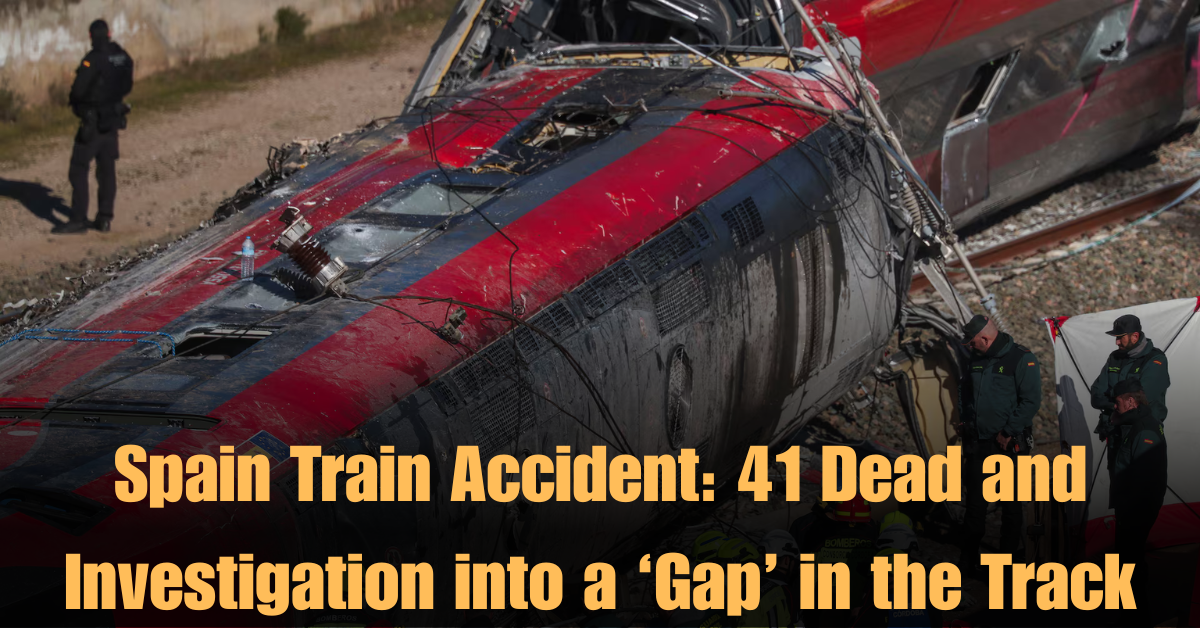
The tragic train accident that occurred on Sunday evening in the Adamuz region of southern Spain has become the center of global attention. As rescue operations enter their third day, the death toll has risen to 41, while investigators are focusing closely on a broken rail segment on the high-speed line.
Horrific Post-Accident Scenes and Rescue Operations
Carriages of a train bound for Madrid derailed and collided with an oncoming train from the opposite direction, leaving more than 120 people injured. Rescue workers continued their operations throughout the second night.
According to authorities, three bodies are still trapped inside a crushed carriage, and heavy machinery is being used to recover them.
The collision near Adamuz is being described as one of the worst rail accidents in Spain in recent decades. Hospitals remain under emergency status, and urgent blood donation appeals have been issued.
Direction of the Investigation: ‘Gap’ in the Track and Technical Factors
In an initial statement, the Interior Minister clarified that no evidence of sabotage has been found. According to preliminary investigative reports, the possible causes of the accident include:
- Broken Track: A “gap” or crack has been detected at one point on the high-speed rail line.
- Track Maintenance: Was timely inspection and maintenance carried out on this specific section?
- Speed Factor: Was the train traveling above the a permitted speed while the approaching a curve?
Table: Key Figures of the Accident
| Details | Numbers |
| Total fatalities | 41 (expected to rise) |
| Number of injured | 120+ |
| Location of accident | Adamuz, Southern Spain |
| Direction of train | En route to Madrid |
| Primary cause (preliminary) | Broken rail |
Safety Measures and the Modern Technology to Prevent Train Accidents
Railway experts suggest several key measures to the prevent such incidents in the future:
- Automatic Train Protection (ATP): An automated system that is controls train speed based on track conditions.
- Ultrasonic Testing: Use of the advanced sensors to detect internal cracks in rail tracks.
- Real-Time Monitoring: 24-hour digital surveillance of the high-speed rail lines.
Frequently Asked Questions (FAQs)
Q: Are trains in Spain safe?
A: Spain’s rail network is the considered one of the most advanced in the world; however, this accident raises serious questions about infrastructure maintenance.
Q: Will passengers receive the compensation?
A: Under Spanish law, affected passengers and the families of victims are entitled to the insurance coverage and the government compensation.
Disclaimer
The information provided in this article is for general informational purposes only. While we try to keep the information up to date and correct, we make no representations or warranties of any kind about the completeness, accuracy, or reliability of the content. Any reliance you place on such information is strictly at your own risk.