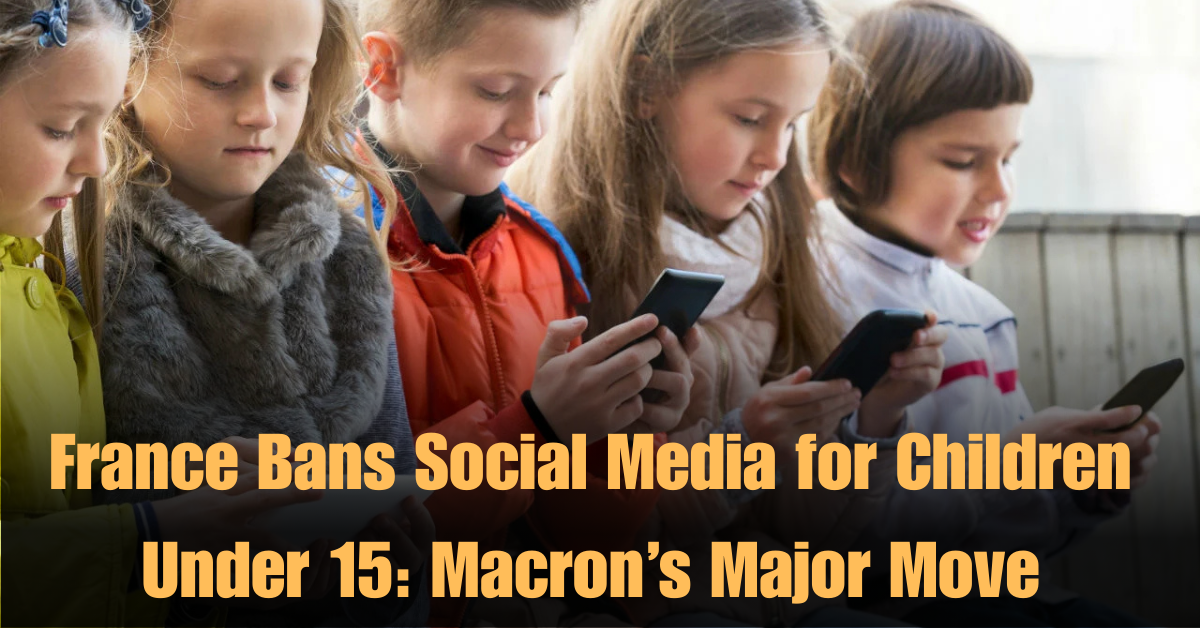
France is standing on the brink of historic legislation that could set an example for the entire world. Following in Australia’s footsteps, debates have begun in the French National Assembly on a new law aimed at restricting access to social media for children under the age of 15.
President Emmanuel Macron has made it clear that he wants this ban implemented by September this year, in time for the start of the new school term. But will this restriction truly protect children’s mental health—or is it merely a political strategy? Let’s take the a closer look at all aspects of this complex issue.
1. Purpose of the Social Media Ban: Protecting Mental Health
The French government’s move is the part of a growing global trend focused on shielding children from is a the harmful effects of the social media. President Macron stated:
“We cannot leave our the children’s mental and emotional health at the mercy of people whose only the goal is to make money from them.”
Key points:
- Harmful platforms: Snapchat, Instagram, and TikTok are being labeled as the most dangerous platforms for children.
- Parental consent: Access to some less harmful websites may still be allowed, but only with explicit parental approval.
- Mobile phone ban: Under the new law, mobile phone use will be completely banned even in senior high schools (lycées). This rule is already in place in junior schools.
2. Legislation and Political Context: Macron’s Final Card?
This bill comes at a time when the President Macron is a facing serious domestic political challenges. After the 2024 elections, the lack of a a clear majority in the parliament pushed him into a weakened position. Analysts believe this social media ban offers a rare opportunity to regain public support.
- Political backing: Macron’s allied parties are the expected to a receive support from a the Republicans (LR) and the right-wing National Rally (RN), increasing the chances of a the bill being passed.
- Fast-track procedure: Prime Minister Sébastien Lecornu has been instructed to push the bill through an accelerated process so it can be approved by September, avoiding delays caused by budget debates and legislative backlogs.
3. The Biggest Challenge: Age Verification
Passing a law is one thing enforcing it is the real test. France now needs to develop a digital mechanism capable of accurately verifying users’ ages.
- Existing system: France already has the an age-verification system in place for adult access to the pornographic websites.
- Clash with EU law: A similar attempt in a 2023 was struck down by courts for violating European regulations. This time, the bill has been rewritten in line with guidance from the Council of State.
4. Global Trends: Are Other Countries Catching Up?
France is not alone in taking this step. A global wave of “digital protection” is underway:
- Australia: Has already introduced strict rules for children under 16.
- United Kingdom: The British government has recently launched consultations on banning social media for under-16s.
- Europe: Denmark, Greece, Spain, and the Ireland are the also considering similar measures.
[Infographic: Comparison of social media age limits across Europe and a Australia]
Frequently Asked Questions (FAQs)
Q: Will this ban apply only to French citizens?
A: Yes, the law will apply to all kids under 15 who live in France.
Q: Can kids get around the ban with a VPN?
A: This is a big technical problem. The government is looking into systems that use official documents to verify identity instead of just IP addresses.
Q: Will the law be followed by September 2026?
A: President Macron is working hard to make it happen by the start of the school year, but it still needs to be approved by the Senate and there are technical problems that need to be worked out.
Disclaimer
The information provided in this article is for general informational purposes only. While we try to keep the information up to date and correct, we make no representations or warranties of any kind about the completeness, accuracy, or reliability of the content. Any reliance you place on such information is strictly at your own risk.