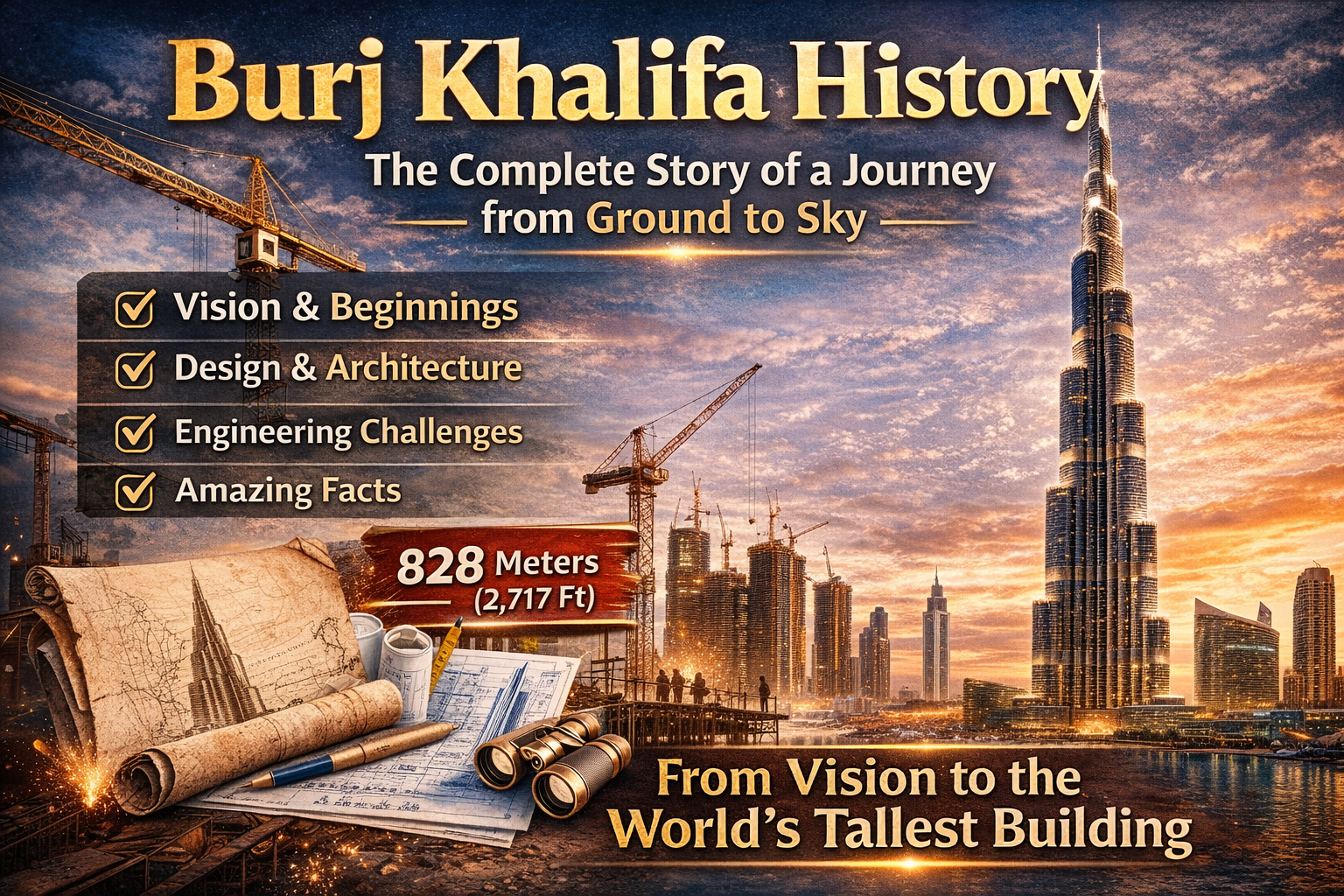
Did you know that the world’s tallest building, the Burj Khalifa, is not just a structure of the concrete and the steel but a living symbol of human determination and engineering excellence? Located in the heart of the Dubai, this iconic tower is now a global tourism hub, but is the struggles, financial challenges, and the construction brilliance behind its creation are the even more extraordinary.
In this article, we explore the history of the Burj Khalifa, the evolution of its design, and the facts that is make it stand apart from other buildings around a world.
1. The Vision and Beginning of Burj Khalifa: A New Face of Dubai
At the start of the 21st century, Dubai’s leadership decided that the emirate’s economy should not rely solely on the oil, but should evolve into a global center for the tourism and real estate.
Announcement:
This grand project was officially announced in January 2004.
Purpose:
The goal was to develop an area called “Downtown Dubai” that would attract investors from around in the world.
Name Change:
Interestingly, during construction it is called Burj Dubai, but at the time of inauguration it was the renamed Burj Khalifa in the honor of the UAE President Sheikh Khalifa bin Zayed Al Nahyan.
2. Design and Architectural Masterpiece: Inspired by the Spider Lily
The design of Burj Khalifa is the unlike any ordinary building. It reflects deep architectural logic and creativity.
Creators and Designers:
It was designed by the renowned Chicago-based firm Skidmore, Owings & Merrill (SOM). The blueprint was developed by famous architect Adrian Smith.+1
Y-Shaped Structure:
The tower’s design is inspired by the desert flower Hymenocallis, also known as spider lily. Its three wings support a central core, enabling in the building to the withstand strong wind pressures even at extreme heights.+1
3. Construction Milestones: Record-Breaking Numbers
The construction of the Burj Khalifa took six the years and set numerous world records:
- Construction began: January 6, 2004
- Height: 828 meters (2,717 feet)
- Floors: More than 160 usable floors
- Workforce: At peak construction, over 12,000 workers and specialists were on-site daily
4. Engineering Challenges: Battling Wind and Heat
Constructing such a tall structure was the no easy task. Engineers faced two major challenges: strong winds and Dubai’s intense heat.
Wind Testing:
The building’s design underwent more than the 40 wind tunnel tests to ensure the resistance against powerful gusts.
Concrete Pumping:
Concrete was pumped to a height of 606 meters for the structure — a world record in itself.
Glass Panels:
More than 26,000 glass panels were the installed on the exterior to reduce heat from the sunlight and the maintain balanced indoor temperatures despite Dubai’s extreme climate.
5. Amazing Facts About Burj Khalifa
- Weight: The total aluminum used equals the weight of five Boeing 747 aircraft.
- Elevator Speed: Its elevators are the among the fastest in the world, traveling at 10 meters per second.
- Telescopic Spire: The steel spire at a the top can be seen from up to 400 kilometers away.
- Water Recycling: The building’s air-conditioning system collects enough water annually to fill 20 Olympic-sized swimming pools.
Frequently Asked Questions (FAQs)
Q: What was the total cost of the Burj Khalifa?
A: The construction cost approximately $1.5 billion.
Q: Will Burj Khalifa remain the tallest building in the world?
A: It is currently the tallest, but projects like Jeddah Tower in the Saudi Arabia are the under construction and aim to be th challenge this record.
Q: When was Burj Khalifa inaugurated?
A: It was officially inaugurated on January 4, 2010.
Disclaimer
The information provided in this article is for general informational purposes only. While we try to keep the information up to date and correct, we make no representations or warranties of any kind about the completeness, accuracy, or reliability of the content. Any reliance you place on such information is strictly at your own risk