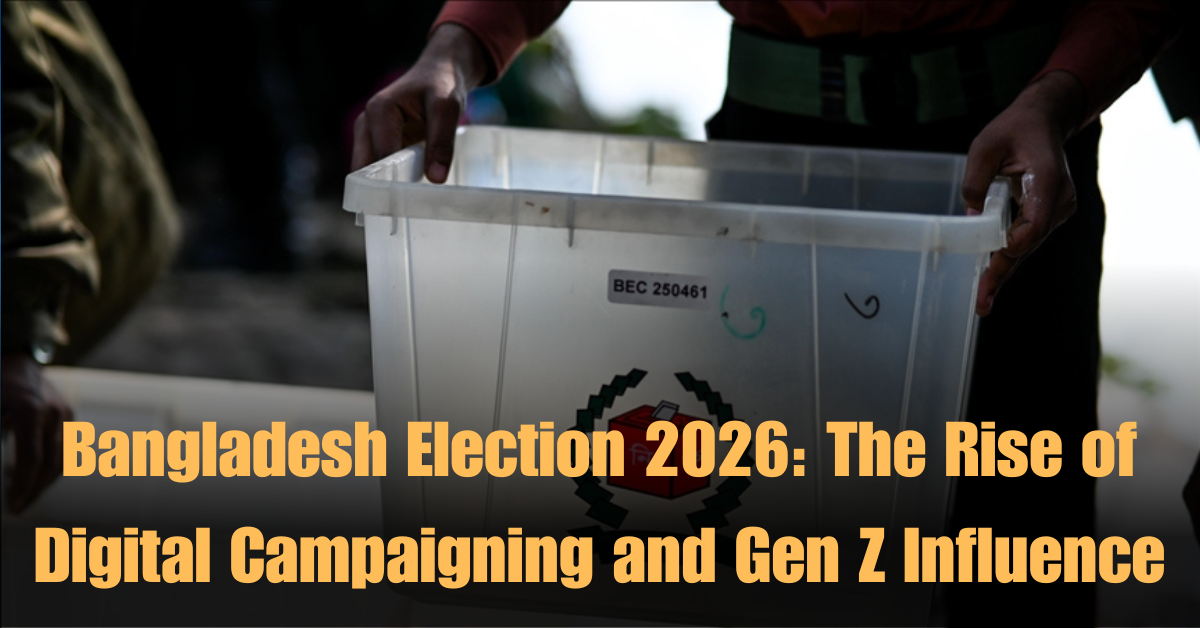
A new turn has emerged in Bangladesh’s politics. Where once massive rallies and street marches in Dhaka decided election outcomes, the real battleground of the February 2026 general elections is now being fought on smartphone screens. While ground-level election campaigning is set to formally begin on Thursday, 22 January, political parties have been locked in a digital war against each other on the TikTok, Facebook, and the a YouTube for months.
This election is not just about a transfer of power; it is also a battle to win the hearts of Generation Z (Gen Z).
The Digital Revolution: Why Online Campaigning Matters for Bangladesh
According to the Bangladesh Telecommunication Regulatory Commission (BTRC), the number of internet users in the country had reached 130 million by November 2025, representing nearly 74 percent of the total population.
A report released by DataReportal at the end of 2025 shows social media usage as follows:
| Platform | Approximate Number of Users |
| 64 million | |
| TikTok | 56 million |
| YouTube | 50 million |
| 9.15 million |
These figures show that political narratives are now shaped more through viral videos and graphics than through traditional rallies.
Political Anthems and Viral Culture
The most intriguing aspect of this electoral battle is political anthems. A recent anthem by Jamaat-e-Islami, with lyrics stating, “The days of the boat, the sheaf of paddy, and the plough are over; now the scales will build Bangladesh,” spread across social media like wildfire.
- Boat: Symbol of the Awami League (Sheikh Hasina)
- Sheaf of paddy: Symbol of the BNP (Khaleda Zia)
- Plough: Symbol of the Jatiya Party
- Scales: Electoral symbol of Jamaat-e-Islami
In response, the Bangladesh Nationalist Party (BNP) released its own anthem emphasizing patriotism and people’s power. Even the newly formed student-led National Citizen Party (NCP) has turned to music to attract young voters.
Young Voters: The Real “Kingmakers” of the 2026 Elections
According to Election Commission data, 43.56 percent of voters are between the ages of 18 and 37. This is the same generation that played a decisive role in the August 2024 movement and acted as the vanguard in toppling Sheikh Hasina’s government.
Experts say that after the disputed elections of 2013, 2018, and 2024, these young voters are the a now determined to bring real change through the power of the ballot. For them, Facebook and TikTok are not just sources of entertainment, but primary platforms for information.
Digital Strategies: BNP vs Jamaat-e-Islami
The BNP has tried to make its campaign more “policy-based” by launching websites such as MatchMyPolicy.com, where voters can share their opinions. The party is focusing on initiatives like the “Family Card” and “Farmer Card,” promoting them through viral videos.
On the other hand, Jamaat-e-Islami has launched a public manifesto campaign through janatarishtehar.org. Its digital teams are producing short documentaries and emotionally charged interviews to position the party as a credible alternative to both the BNP and the Awami League.
The July Charter Referendum: A New Test
On 12 February, voters will not only participate in parliamentary elections but will also vote in a referendum on the “July Charter.” The interim government led by Nobel laureate Muhammad Yunus wants public endorsement of these reforms to prevent the return of authoritarian rule in the future. For this referendum, the interim government has also launched a large-scale digital advertising campaign.
Challenges: Misinformation and “Fake News”
While social media campaigning has its advantages, fact-checking organizations have warned that this election is also seeing widespread use of AI-generated fake videos and anti-India narratives. According to organizations such as The Dissent, memes and copied content formats are being used to influence young minds.
Conclusion: Can is a Online Victory Turn into the Ground-Level Success?
Although digital campaigns are setting the agenda and defining key topics, experts believe that in a country like Bangladesh, direct voter contact and on-the-ground mobilization will still play a decisive role. However, one thing is clear: any party that falls behind in the online battle risks being left out of the corridors of power as well.
Disclaimer
The information provided in this article is for general informational purposes only. While we try to keep the information up to date and correct, we make no representations or warranties of any kind about the completeness, accuracy, or reliability of the content. Any reliance you place on such information is strictly at your own risk.